
Do Audiobooks Count? The Neuroscience of Reading vs. Listening
December is here. It is the last month of the year, and readers all over the world are sharing their final book counts.
But with those lists comes a dilemma I see all over social media: Do audiobooks count as reading? (Usually, I see more people angry at the “non-believers” than discussing the actual topic, but the question remains).
This is not a mere opinion post. We are going to resolve this conflict in the most objective way possible: The scientific way. We are looking strictly at facts, data, and brain scans.
To begin, I want to address the common assumption. My gut instinct used to tell me that reading a book is not the same as listening to an audiobook. My logic was simple: Reading is a visual activity, while listening is an auditory one. You are engaging different senses, so it can’t be the same, right?
That uncertainty led me to investigate. Here is what the science says.
The Research
To answer this question, we must separate the mechanical act (decoding symbols) from the cognitive goal (comprehension).
1. The “Shared Meaning” Network
First, let’s look at how the brain processes stories. In a landmark study from the Gallant Lab at UC Berkeley, researchers mapped the brain’s semantic representation (the meaning of words) while participants listened to stories and then read the same stories.
The result? The semantic maps were invariant to stimulus modality.
This means that the specific brain regions that process the meaning of a story (e.g., the concept of “family” or “danger”) are identical whether you read or listen. In simpler words, once the word is “inside” your head, the brain processes the narrative in the exact same way.
Score one for the audiobook believers.
2. The Distinct Networks (How Information Enters)
But what about the entry methods? Aren’t they different? The answer is yes. While the processing of meaning is the same, the entry points are physically different.
Reading (The Visual Pathway) When you physically read, the primary region occupied is the Visual Word Form Area (VWFA), located in the left fusiform gyrus. Neuroscientists often call this the brain’s “letterbox.”
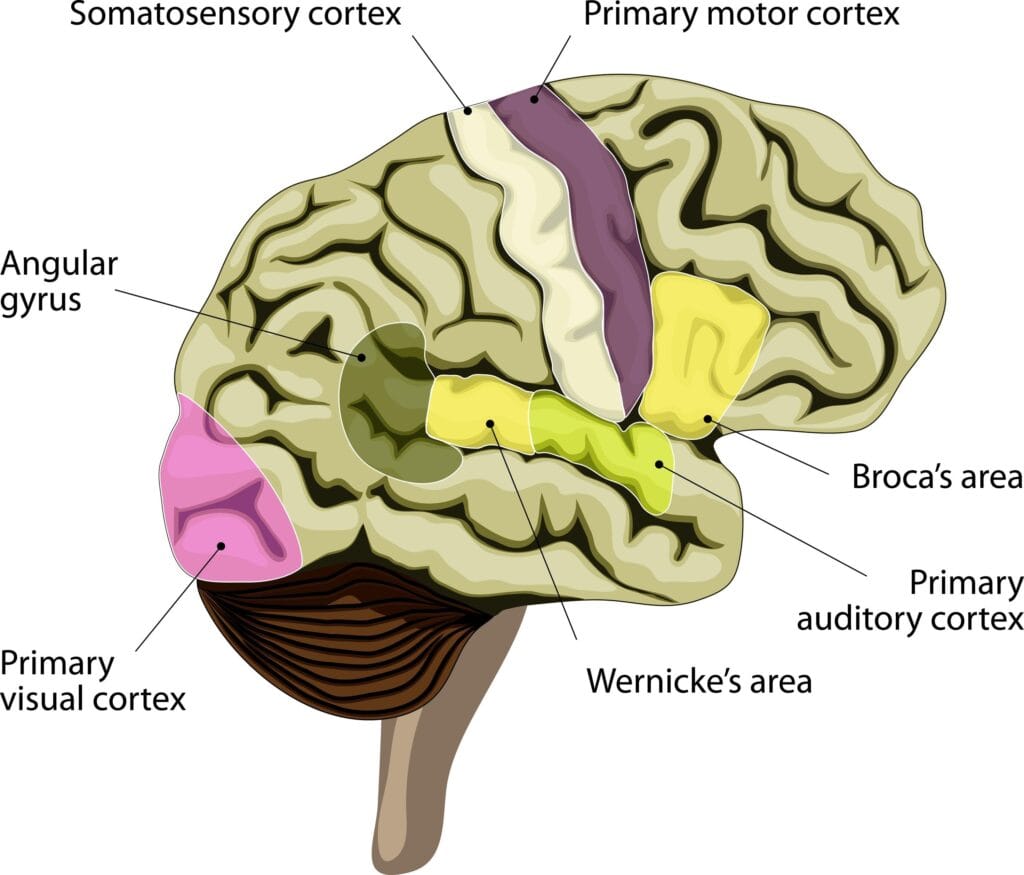
This area instantly recognizes written words as language rather than just shapes. This connects to the Occipital Lobe, which handles visual processing.
In terms of cognitive load, reading involves decoding. The brain must translate symbols into sounds and meanings. This requires “top-down” attention, allowing the reader to control the pace and re-read (regress) if focus is lost.
Listening (The Auditory Pathway) When you listen, the primary region occupied is the Superior Temporal Gyri (Primary Auditory Cortex). This area processes sound waves, rhythm, and prosody (tone and intonation).
In terms of cognitive load, listening relies on prosody. The speaker’s intonation aids comprehension—for example, sarcasm is much easier to hear than to read. However, the listener cannot control the pace easily, making complex non-fiction harder to retain if the mind wanders.
3. The Simple View of Reading
In educational psychology and neuroscience, this dynamic is often expressed by the ‘Simple View of Reading’ formula:
Reading = Decoding * Language Comprehension
- Audiobooks remove the “Decoding” variable but maximize “Language Comprehension.”
- Physical Reading requires both.
This mechanical difference is exactly why audiobooks are such a great tool to help you get out of a reading slump. They allow you to keep the narrative flow going without the mental friction of visual decoding.
So yes, strictly speaking, physical reading does require more mechanical effort. But don’t get me wrong — I am not saying that listeners take the easy way out. If anything, retaining attention to something happening in real-time (without the ability to glance back) is harder than it looks. Half of my classmates can corroborate that!
The Verdict
So, do audiobooks count?
If your definition of reading is absorbing a story, then yes, science proves that audiobooks absolutely count. Your brain builds the same world, feels the same emotions, and processes the same concepts.
However, if you care about the mechanical science behind it, physical reading is a unique mental workout for decoding that audiobooks cannot replicate.
Did you know about the brain’s ‘letterbox’ or the ‘Simple View of Reading’ formula before today? Let me know in the comments which scientific fact surprised you the most!